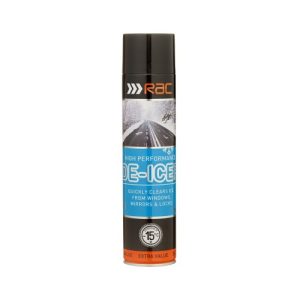
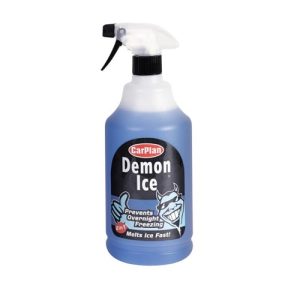
A de-icer is a spray that melts ice on glass so you can clear it before driving. It works best alongside a scraper and the car’s own heating, and the law expects you to be able to see properly before you set off. This page covers what to use, what to avoid and the rules that apply. Our research on specific products is listed below.
Last updated: 19 October 2026
What to use
- De-icer and a scraper on the outside. The AA says to use a scraper and de-icer on the outside while the inside warms up [1].
- Warm air inside. The AA says to turn the blower on to the windscreen, use the rear and mirror heaters if fitted, and run the air conditioning to remove moisture [1].
- A soft brush for the grille. The AA suggests a soft brush for the front grille [1].
- A lint-free cloth for mist. The AA says not to wipe misted windows by hand, and to use a lint-free cloth instead [1].
- Think ahead. The AA suggests parking in a garage or near the house, or putting cardboard over the windscreen overnight [1].
What to avoid
- Hot or lukewarm water. The AA says not to use it. Temperature changes can crack glass, especially if it is already chipped, and warm water can refreeze and make more ice [1].
- Wipers on a frozen screen. The AA says to check the wipers are off before you start the car. If they are frozen to the glass, the motor could be damaged or the rubber torn [1].
- Clearing a small gap. The AA warns that clearing only a small viewing gap could lead to police action for driving dangerously [1].
- Leaving the car running unattended. See the rules below.
The rules
These points come from the Highway Code, the regulations and the AA. They are guidance, not legal advice.
- Before you set off. Highway Code rule 229 says you must be able to see, so clear all snow and ice from all your windows. It also says lights must be clean and number plates clearly visible, mirrors clear and windows demisted thoroughly, and that you should remove snow that might fall into the path of other road users [2].
- Fine for obscured vision. The AA says driving with obscured vision can bring a £100 fine and 3 points on your licence [1]. Check the current penalty before relying on it.
- Engine running. Regulation 107 says you must not leave a motor vehicle on a road not attended by a person licensed to drive it unless the engine is stopped and any required parking brake is set. The exceptions listed are for emergency service and certain work uses, not for defrosting [3].
- Theft. The AA says thieves target unattended cars with the engine running, a crime it calls “frosting”. It says insurers may not cover theft where keys were left in an unattended car. If you must go indoors, it says to switch off and lock the car [1].
Questions people ask
Can I use hot water on a frozen windscreen?
No. The AA advises against even lukewarm water. It can crack the glass, particularly if the glass is chipped, and it can refreeze [1].
Is it illegal to leave the engine running while I defrost?
On a road, regulation 107 prohibits leaving the vehicle unattended with the engine running [3]. The AA advises staying with the car while the engine runs [1]. Check the rules for private land with the landowner and your insurer.
Do I have to clear snow off the roof?
Highway Code rule 229 says to remove all snow that might fall off into the path of other road users [2].
Do I need a de-icer if I have a scraper?
The AA’s advice is to use a scraper and de-icer together on the outside while the inside warms up [1]. It does not say a scraper alone is not enough, so the choice is yours.
Recalls and safety
Check the label and any hazard warnings on a de-icer before you use it. Our product safety and recalls page explains how we check.
We searched the official recalls list for “de-icer” on 19 October 2026. It returned 34 results, and the first eight were not de-icer or ice scraper products (they were fragrances, skin care and an e-bike). We did not read the rest [4]. Search the official recalls list for your brand. Recalls checked 19 October 2026.
Sources
- How to defrost a car windscreen: step-by-step guide, The AA, theaa.com. The page shows no date. Checked 19 October 2026.
- The Highway Code: Driving in adverse weather conditions (226 to 237), GOV.UK, gov.uk. Checked 19 October 2026.
- The Road Vehicles (Construction and Use) Regulations 1986, regulation 107, legislation.gov.uk. Checked 19 October 2026.
- Product safety alerts, reports and recalls, Office for Product Safety and Standards, GOV.UK. Searched 19 October 2026.